Why Does Your Skin Feel Dry Even After Moisturizing?
Why skin can still feel dry after moisturizing, how hydration differs from transepidermal water loss, and how to build a calmer, evidence-led routine.
8 min read By Dr. Lurié Science Editorial Team Skin Concerns #Dry Skin #Skin Barrier #Moisturizers #Skin Science #Skincare Basics
Why immediate softness may not last
You apply moisturizer and your skin feels comfortable. A few hours later, tightness or roughness returns. That does not automatically mean the product has failed, and it does not diagnose a damaged skin barrier.
A moisturizer can increase water in the outer skin, reduce water loss from the surface, smooth roughness, or combine these effects. Those outcomes overlap, but they are not interchangeable. The useful question is not simply whether a product “adds moisture,” but which part of the water-retention system it supports—and whether cleansing, climate, irritation, or a skin condition is working against it.
What does it mean for skin to be hydrated?
The stratum corneum: cells plus an extracellular lipid matrix
The stratum corneum is the outermost epidermal layer. Flattened corneocytes sit within an extracellular matrix rich in ceramides, cholesterol, and free fatty acids. The organization of these lipids helps regulate permeability and water movement; the familiar “bricks and mortar” analogy is useful, but it is a simplification of a layered, dynamic structure. [1]
Natural moisturizing factor: water-binding material inside corneocytes
Corneocytes also contain natural moisturizing factor, or NMF: a mixture that includes amino acids, pyrrolidone carboxylic acid, lactate, urea, and related small molecules. Many components arise during filaggrin breakdown. They help the stratum corneum bind water and remain flexible. [2]
Hydration and TEWL answer different questions
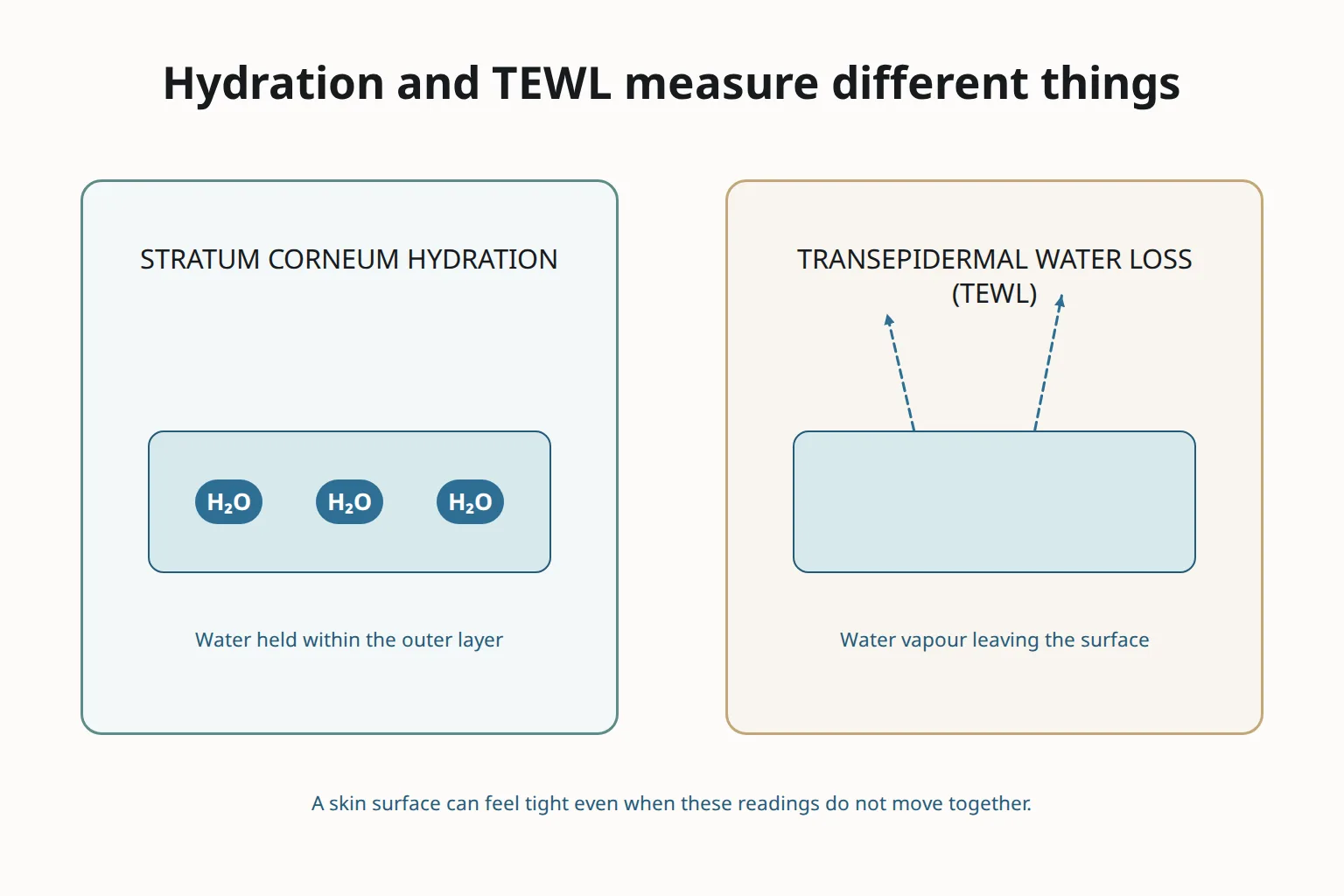
Corneometry estimates water-related electrical properties near the skin surface. Transepidermal water loss, or TEWL, estimates the rate at which water vapor leaves the skin. Both measurements are sensitive to methods, body site, temperature, and humidity, so neither should be treated as a stand-alone diagnosis. [3]
A 2024 randomized, double-blind study in 36 nursing-home residents compared lotions containing low- or high-molecular-weight hyaluronic acid with a vehicle on separate areas of the leg. The low-molecular-weight formulation produced higher capacitance after four weeks, but the groups did not differ significantly in TEWL or symptom scores. This is evidence about the tested formulations and population—not proof that every low-molecular-weight hyaluronic acid product is superior. [4]
Five reasons skin may still feel dry
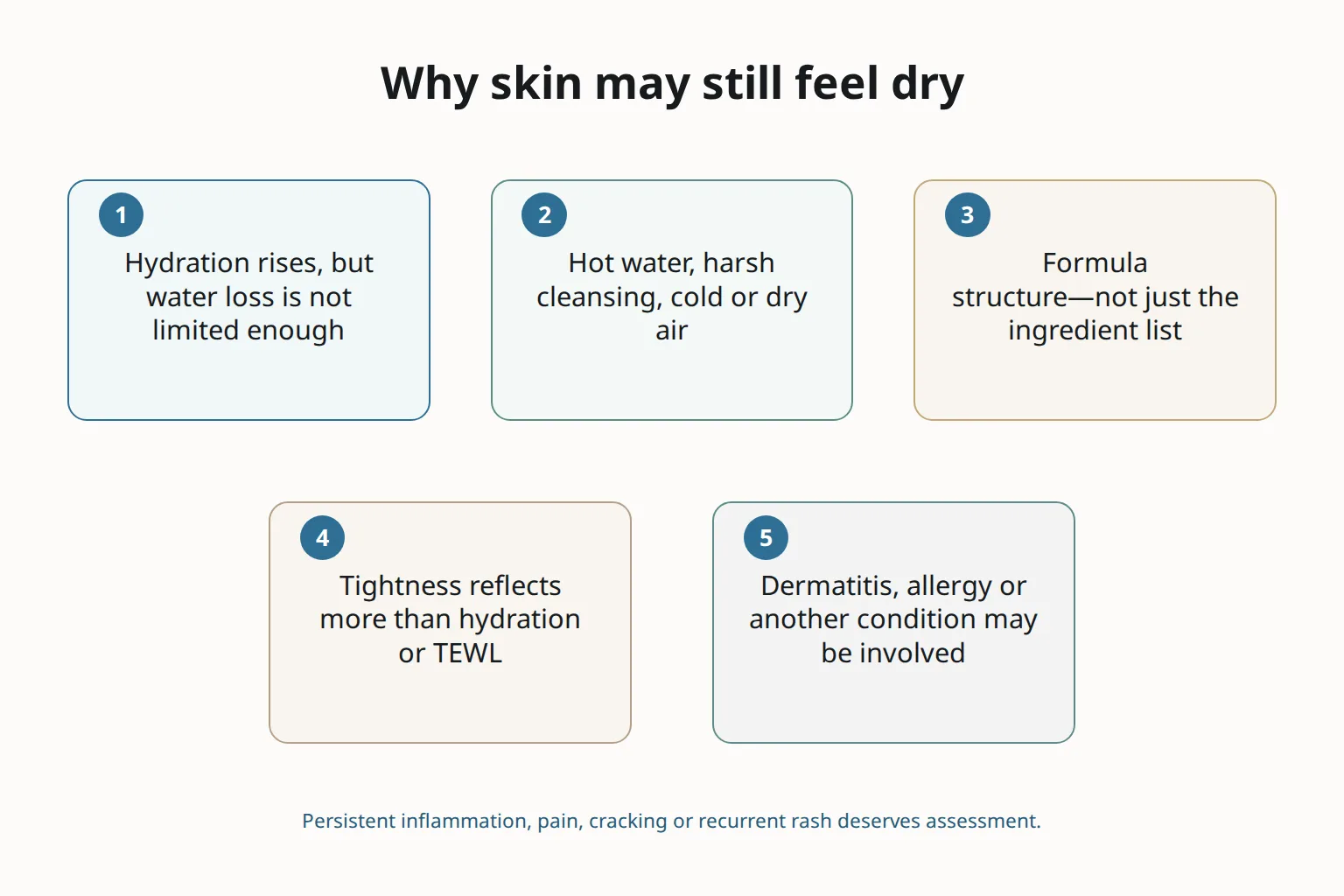
1. The formula raises hydration but does not limit water loss enough
In a randomized crossover study of 51 people with dry skin, glycerol-containing components contributed mainly to higher corneometry readings, while petrolatum-containing components contributed mainly to lower TEWL over the 12-hour test period. The complete cream combined both effects. The study supports complementary mechanisms within that formulation; it does not establish that every product needs those exact ingredients. [5]
2. Tightness is not a barrier test
A 2022 study combined clinical observations, biomechanical measurements, laboratory work, and modeling. In its population, perceived tightness was not explained by corneometry or TEWL alone; stratum-corneum mechanical stress was relevant. The work had industry involvement, so it is best read as mechanistic evidence rather than a universal diagnostic rule. [6]
3. Cleansing and the environment keep resetting the problem
Frequent washing, harsh surfactants, hot water, low humidity, cold weather, and indoor heating can repeatedly challenge dry skin. Applying more moisturizer may give only temporary comfort if the same exposures continue.
4. Similar ingredient lists can behave differently
Concentration, emulsion structure, film formation, stability, and the interaction of ingredients all matter. In a randomized study of 49 adults with atopic dermatitis, three emollient creams produced different barrier-related outcomes. Those results apply to the specific products and an atopic-dermatitis population; they should not be generalized to every person with cosmetic dryness. [7]
5. The problem may not be ordinary cosmetic dryness
Persistent scaling, inflammation, pain, cracking, or itch can occur with dermatitis, psoriasis, allergy, medication effects, or systemic illness. A position paper on xerosis emphasizes evaluating symptoms, exposures, associated conditions, and individual needs rather than repeatedly switching cosmetics. [8]
How moisturizers work: three overlapping mechanisms
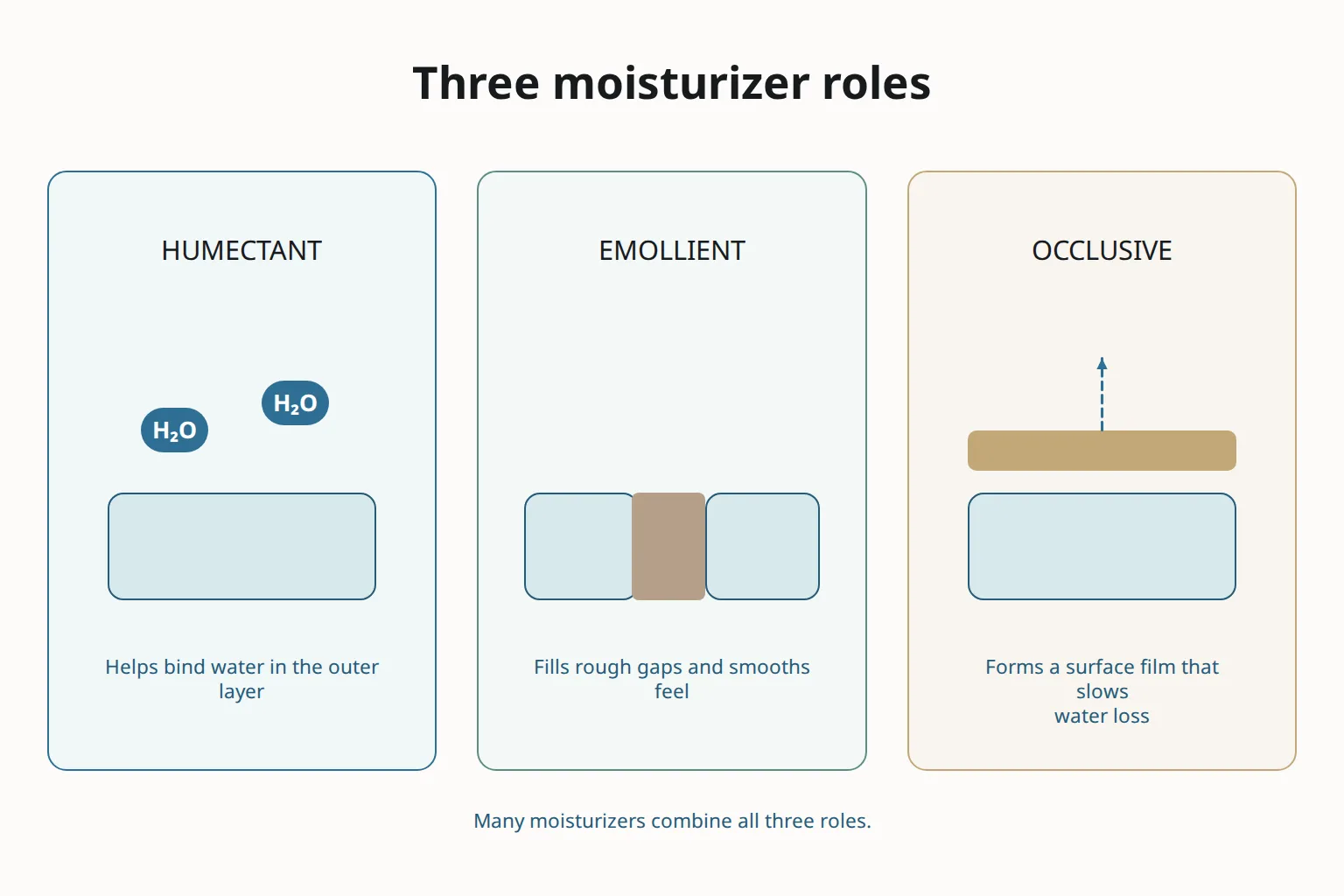
Humectants help the stratum corneum bind water
Glycerol, urea, sodium PCA, and hyaluronic acid are examples. Their effects depend on concentration, vehicle, and the rest of the formula. Ingredient research does not prove that every finished product containing that ingredient performs the same way.
Occlusives reduce evaporation from the surface
Petrolatum, dimethicone, mineral oil, and some waxes can contribute to a surface film that limits water loss. The degree of occlusion depends on dose, distribution, and formulation.
Emollients smooth roughness; some lipids may also support barrier organization
Emollients fill and smooth surface irregularities, improving feel and flexibility. Ceramides, cholesterol, and free fatty acids are also natural parts of the extracellular lipid matrix, but seeing one of these words on an ingredient list does not establish clinical performance. A randomized eczema study of a ceramide-dominant cream-and-cleanser regimen improved hydration and TEWL compared with its control regimen, but it tested a two-product system in adults with eczema and did not isolate a single ingredient. [9]
Why more expensive or more complex is not necessarily better
An ingredient list cannot show concentration or structure
Two products can share headline ingredients but differ in concentration, emulsion type, sensory profile, preservation, stability, and how long they remain on the skin.
Clinical endpoints are not interchangeable
Immediate softness, higher corneometry, lower TEWL, less itching, and improvement in a diagnosed disease are different outcomes. A study supporting one should not be used to imply all the others.
Hyaluronic acid is not a complete answer by itself
Hyaluronic acid can contribute to hydration in a tested formula, but molecular weight alone does not predict how a retail product will perform. Vehicle, concentration, tolerability, and complementary emollient or occlusive components remain important.
A practical routine for recurrent dryness
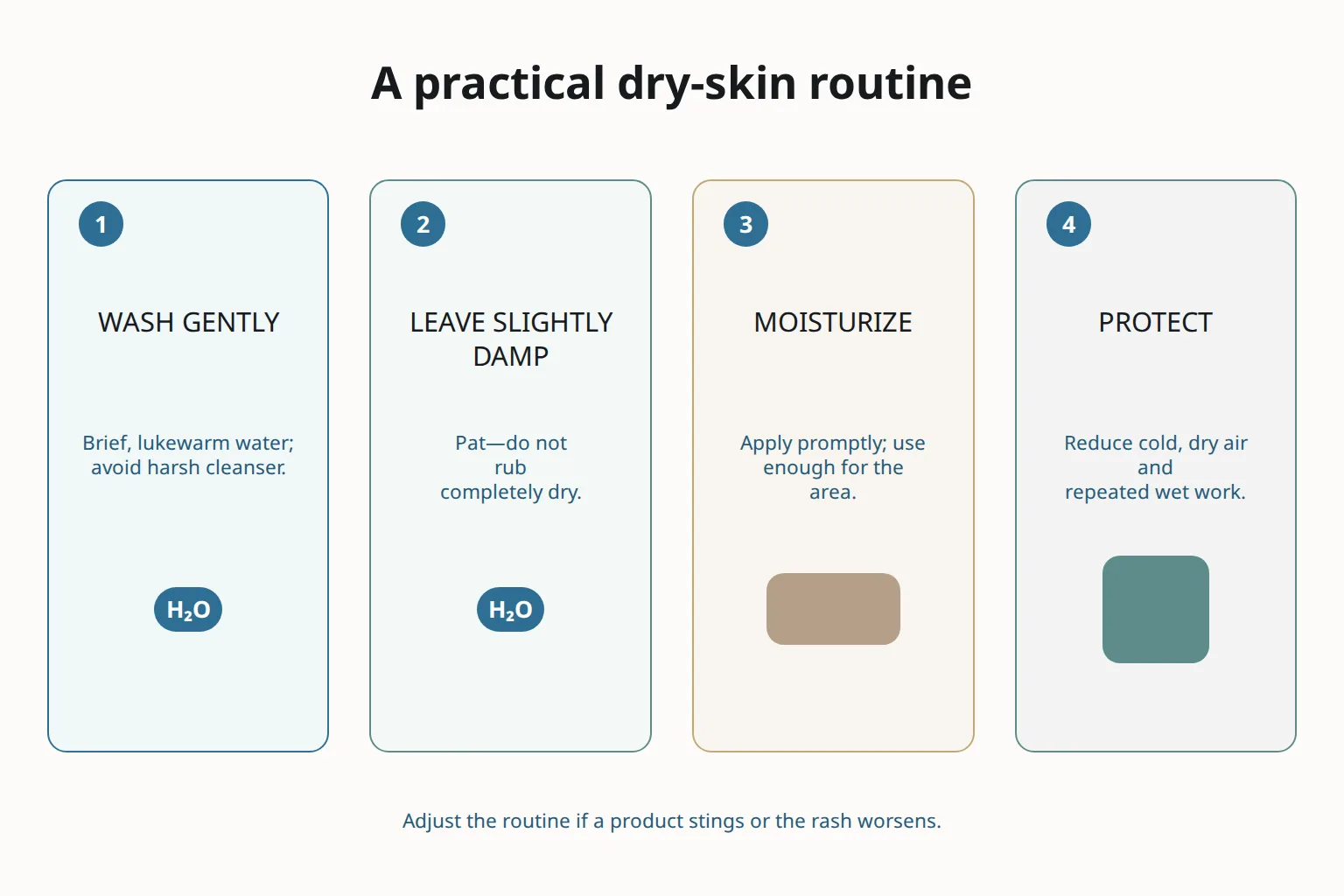
1. Make cleansing gentler
Use lukewarm water and a mild, fragrance-free cleanser where cleansing is needed. Avoid scrubbing and unnecessarily long hot showers.
2. Apply moisturizer soon after washing
Pat rather than rub the skin dry, then apply moisturizer while the surface is still slightly damp. This can help retain some of the water introduced during washing.
3. Match texture to the situation
A light lotion may be comfortable for mild dryness or humid weather. A cream or ointment may provide more persistence in cold, dry conditions or on very dry areas. Comfort and tolerability matter because consistent use is more informative than one application.
4. Evaluate more than the first five minutes
Over several days, notice whether comfort lasts longer, scaling decreases, and the product remains tolerable. Hydration can change within hours to days; barrier comfort may take days to weeks. These are evaluation windows, not promises.
5. Change one variable at a time
If irritation is present, simplify the routine and introduce only one new product at a time. Stop a new product if irritation persists or worsens.
When dryness deserves medical assessment
See a clinician if dryness is persistent despite a gentle routine, or if it is accompanied by substantial redness, swelling, pain, bleeding cracks, sleep-disrupting itch, or repeated flares.
Severe, painful, or blistering reactions, persistent facial redness—especially with eye symptoms—or a recurring rash or suspected product allergy are reasons for professional assessment rather than continued cosmetic experimentation.
Frequently asked questions
Why does my face feel tight after moisturizer?
Tightness can reflect dryness, irritation, product film behavior, or changes in stratum-corneum mechanics. It does not, by itself, prove barrier damage.
Can dehydrated skin still be oily?
Yes. Surface oil and water content are different variables, so skin can feel tight while also appearing oily.
Is hyaluronic acid enough for dry skin?
It may support hydration, but some people need a formula that also smooths roughness or limits water loss. Performance depends on the complete product.
How is hydration different from barrier function?
Hydration describes water associated with the outer skin. Barrier function concerns how effectively skin regulates movement of water and other substances. Corneometry and TEWL provide related but different information.
Why does skin become dry again after washing?
Water exposure can briefly increase surface hydration, while heat, surfactants, and evaporation can leave the skin feeling drier afterward. Gentle cleansing and prompt moisturizing can reduce that cycle.
When should persistent dryness be checked?
Seek assessment when dryness persists despite a simple routine or is accompanied by marked inflammation, pain, bleeding cracks, severe itch, or recurrent rash.
Read next
Niacinamide for the aging skin barrier explains what ingredient evidence can—and cannot—say about barrier support.
Skincare after 50: a simple routine puts moisturizer into a low-friction morning and evening routine.
Retinol vs. bakuchiol when retinol irritates helps separate active-related irritation from ordinary dryness.
Sources and DOI references
[1] van Smeden & Bouwstra, Stratum Corneum Lipids (2016)
[2] Voegeli et al., Moisturizing at a molecular level (2023)
[3] du Plessis et al., International TEWL and hydration guidelines (2013)
[4] Muhammad et al., topical hyaluronic acid molecular weights in older adults (2024)
[5] Vaillant et al., glycerol and petrolatum crossover study (2020)
[6] Hendrickx-Rodriguez et al., decoding skin tightness (2022)
[7] Danby et al., emollient formulations in adults with atopic dermatitis (2022)
[8] Augustin et al., xerosis cutis position paper (2019)
[9] Spada et al., ceramide-dominant moisturizer and cleanser regimen (2021)
Practical routine guidance was also checked against the American Academy of Dermatology’s dry-skin guidance.