How Long Does Skincare Take to Work? A 4-, 8-, and 12-Week Guide
Not sure if your skincare is working or irritating your skin? Use 4-, 8-, and 12-week checkpoints to decide when to continue, simplify, pause, or ask your dermatologist.
8 min read
How long should you give skincare before judging it?
If you have started a new skincare active, it is very normal to wonder: how long should I give this before deciding whether it works?
The safest answer is not a single number of days. Skin is usually easier to judge by pattern and trend than by one good morning or one bad night.
A product can disappoint for several reasons. It may be the wrong fit for your skin, it may be irritating your barrier, it may not have had a consistent trial, or the concern you are treating may need medical care rather than more products.
This guide uses 4-, 8-, and 12-week checkpoints. They are not guarantees. They are practical moments to pause, look at what is happening, and decide whether to continue, simplify, stop experimenting, or ask your dermatologist.
Quick reference: use checkpoints, not guarantees
These checkpoints are meant to help you notice patterns. They are not promises that your skin should look a certain way by a certain week.
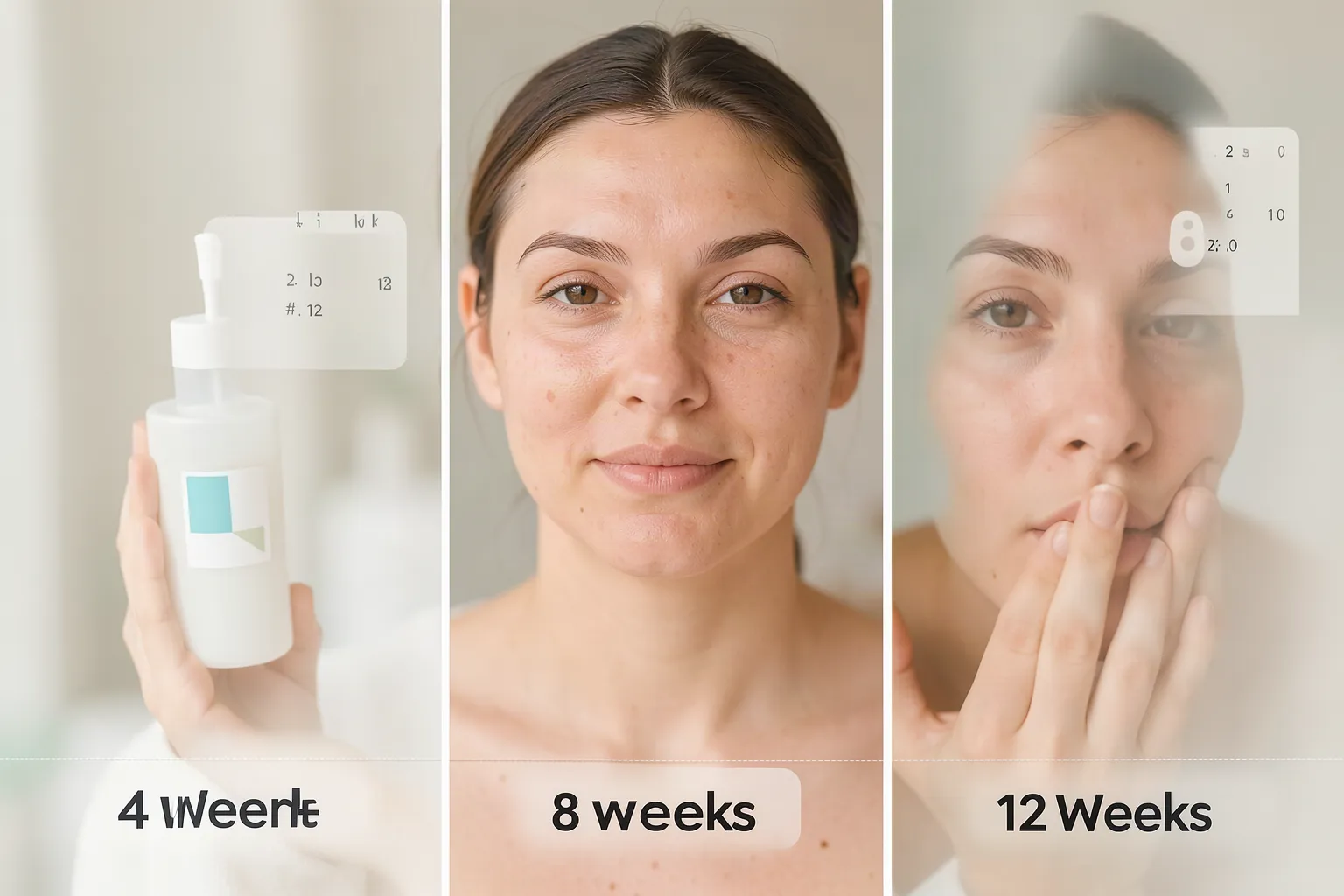
- Around 4 weeks: check consistency and irritation before expecting transformation.
- Around 8 weeks: look for directional change, such as comfort, fewer setbacks, or subtle improvement in the concern you are tracking.
- Around 12 weeks: reassess a consistent, tolerable trial and decide whether to continue, simplify, or ask a dermatologist.
Why skincare timelines are rarely exact
Skincare timelines vary because skin conditions and ingredients do not all behave the same way. Acne, pigmentation, rough texture, dryness, redness, and barrier irritation can each change on different timelines.
Results also depend on the formulation, concentration, how often you use the product, your baseline skin condition, your tolerance, and whether the rest of your routine supports the skin barrier.
Marketing often makes skincare sound more exact than real skin is. A product may claim a visible change in a neat window, but in most people, the more useful question is whether the overall pattern is moving in the right direction without creating ongoing irritation.
This is especially true for acne-prone skin. StatPearls describes acne as a chronic inflammatory condition with several contributing factors, including oil production, clogged follicles, Cutibacterium acnes, and inflammation. That kind of process is not always fairly judged from a single bad week.
First checkpoint: can your skin tolerate it?
Before you look for transformation, ask whether your skin can tolerate the new product.
Some active ingredients can cause mild dryness or flaking, especially early on or when they are used too aggressively. But irritation is not proof that a product is working. It is information your skin is giving you.
Burning that does not settle, swelling, hives, crusting, oozing, eye-area involvement, a widespread rash, rapid worsening, or persistent irritation should not be pushed through. Those patterns deserve guidance from a dermatologist or another appropriate clinician.
This does not mean every small change is dangerous. It means tolerance comes first. A routine that repeatedly disrupts your barrier is harder to evaluate, even if the ingredient itself has evidence behind it.
Around 4 weeks: check consistency and irritation, not transformation
At around 4 weeks, the goal is not to demand a dramatic result. The goal is to ask better questions.
Have you used the product consistently enough to learn anything from it? Has your routine stayed mostly stable, or have several new products been added at once? Is your skin feeling more comfortable, about the same, or increasingly irritated?
Photos can help if you take them in similar lighting and from similar angles. They are most useful when they help you see a trend, not when they encourage you to inspect every pore every day.
No obvious visible change at this point does not automatically mean the product has failed. But worsening comfort, repeated stinging, or a pattern that feels less stable is worth taking seriously.
Around 8 weeks: look for directional change
At around 8 weeks, you can start looking more closely for direction.
Depending on the concern, a useful trend might be fewer new breakouts, smoother-feeling texture, a slightly more even-looking tone, or a skin barrier that feels less reactive. The change may be subtle. It may also show up first as fewer setbacks rather than a dramatic improvement.
If irritation keeps returning, the routine may need to be simplified even if the ingredient is theoretically useful. An active that your skin cannot tolerate in your real routine is not helping you in a practical way.
This is also a good time to notice whether you are trying to speed things up by adding more. More products can make it harder to know what is helping, what is irritating, and what is simply noise.
Around 12 weeks: decide whether to continue, simplify, or reassess
Around 12 weeks can be a reasonable point to reassess a consistent, tolerable trial. Again, this is not a promise that all ingredients should show a specific result by this date.
If there is some directional improvement and your skin feels comfortable, continuing may make sense. If there is no useful change, or if the routine only works when your skin is irritated, it may be time to simplify or rethink the plan.
Worsening acne, painful lesions, early scarring, persistent irritation, or pigmentation concerns are reasons not to keep endlessly experimenting on your own. StatPearls notes that acne can lead to hyperpigmentation and scarring, and the American Academy of Dermatology describes dermatologist care as individualized to the person and the pattern of acne.
A dermatologist can help assess whether the pattern could fit acne, dermatitis, rosacea, melasma, product irritation, infection, or another skin concern. That clarity can reduce trial-and-error rather than add another step for its own sake.
What this means for common skincare ingredients
Different ingredients call for different expectations. The safest way to compare them is by category, not by promising an exact week when results should appear.
- Retinoids often require patience and can irritate, especially when overused or layered into an already active routine. Do not treat severe or persistent symptoms as something you must endure because the product is “working.”
- Vitamin C, if it helps your skin, often does so gradually and subtly. Formulation and stability matter, and not every product will suit every person.
- Niacinamide can support barrier-focused routines in some formulations. It should not be treated as a stand-alone answer for every concern, including acne, redness, or pigmentation.
- AHAs and BHAs may change surface smoothness earlier than they change deeper-looking pigmentation or acne patterns. Overuse can irritate, which may make the skin look and feel worse even when the ingredient category has a reasonable purpose.
- Sunscreen is best understood as protection for the progress you are trying to make, especially when pigmentation is a concern. It should not be framed as a quick dark-spot solution, but reducing UV exposure can be an important part of a steady routine.
A note on purging: do not self-diagnose a bad reaction
Many acne-prone readers hear that breakouts after starting an active are “purging.” The difficult part is that not every breakout after a new product is purging.
Irritation, an allergic-type reaction, an acne flare, rosacea, perioral dermatitis, infection, or another skin condition can be mistaken for purging. From the mirror alone, it is not always possible to tell the difference safely.
If a reaction is severe, spreading, painful, swollen, hive-like, oozing, crusting, near the eyes, or rapidly worsening, do not keep testing the theory at home. Ask a dermatologist or another appropriate clinician for guidance.
For milder uncertainty, the pattern still matters. If the skin is repeatedly more irritated each time you use the product, or the pattern is continuing, worsening, or repeating every time the product is used, do not rely on “purging” as the explanation. Simplifying the routine or asking for guidance is safer than guessing.
Before adding more products, simplify what you are testing
When skincare is not working, it is tempting to add the next active, then the next one after that. The problem is that a crowded routine makes the experiment harder to read.
For many people, a basic cleanser, moisturizer, sunscreen, and one new active at a time is easier to evaluate than several new products introduced together. It gives you a clearer view of what your skin tolerates and what may be changing.
The American Academy of Dermatology emphasizes skin-care habits as part of acne management, and StatPearls notes that repeated mechanical trauma, such as scrubbing, can contribute to acne-related irritation. In practical terms, more effort is not always better for the skin barrier.
If your skin feels tight, hot, stingy, flaky, or reactive, simplifying may be more useful than escalating. A calmer routine often gives you better information and may reduce both irritation and the cost and frustration of guessing.
When to ask a dermatologist
Ask your dermatologist, or another appropriate clinician, if your skin is worsening, painful, scarring, repeatedly irritated, or not improving after a consistent and tolerable trial.
It is also wise to ask before starting, stopping, or combining active ingredients if you are pregnant, treating a child, using prescription skincare, recently had a procedure, or managing acne, rosacea, melasma, eczema, or another skin condition.
If you do make an appointment, bring your product list, a rough timeline, photos if you have them, and notes on what your skin felt like. Those details can make the conversation more useful and may help reduce the cycle of guessing.
Skincare does not have to be judged day by day. Tolerance first, consistency second, trend third. That order can help you make calmer, safer decisions about what belongs in your routine.