Are You Getting the SPF on the Bottle? How to Apply Sunscreen More Effectively
SPF labels are tested under standard conditions. Learn how amount, coverage, and reapplication affect the sun protection you get in real life.
8 min read By Dr. Lurie
Are you getting the SPF on the bottle?
If you apply sunscreen before a morning commute, a long walk, a beach day, or a weekend outside and still wonder whether you are getting the protection promised on the label, that is a reasonable question.
The short answer is: the SPF number is not fake. It is measured under standardized testing conditions. But the protection you get in daily life depends on what happens after the bottle is opened: how much you apply, how evenly you cover your skin, and whether you reapply when the sunscreen film has been disrupted.
The goal is not to measure sunscreen like a lab. The goal is to build a routine that gets you closer to the labeled SPF in a practical, repeatable way.
For many people, the bigger gap is not the SPF number itself, but how much product reaches the skin and how evenly it stays there.
What SPF tells you — and what it does not
SPF stands for sun protection factor. In simple terms, it is a tested measure related mainly to protection from UVB rays, the part of ultraviolet light most closely tied to sunburn.
That does not mean SPF tells the whole story. UVA exposure also matters for skin health, which is why broad-spectrum labeling is important. In the U.S., a sunscreen labeled broad spectrum has met testing requirements related to UVA protection as well as SPF testing.
Dermatology guidance commonly recommends using a broad-spectrum sunscreen with SPF 30 or higher on exposed skin. Water resistance matters when you are swimming or sweating, but it does not mean the sunscreen stays unchanged all day.
So the label matters. It gives you useful information. It just cannot control whether the product is applied in a thick enough, even enough layer once you are using it in real life.
Why the amount you apply changes the protection you get
SPF testing uses a standardized amount of sunscreen on the skin. That controlled setting is useful for understanding the label, but it is not a realistic measuring task for most people at home. You should not need a scale or a ruler to use sunscreen well.
The practical issue is that, in daily use, it is easy to apply less sunscreen than the amount used in testing. People also miss edges, thin out product while rubbing, or apply carefully to the face but much less carefully to the neck, ears, hands, or feet.
A thin or patchy layer can still provide some protection. It just may not give you the full protection reflected by the SPF on the bottle.
It is also worth being careful with the math. You cannot reliably say that half the sunscreen gives half the SPF. Real skin, product texture, sweating, rubbing, and uneven coverage make the relationship more complicated than that.
How much sunscreen to use in real life
Instead of trying to recreate a lab measurement, aim for a generous, even layer over every area of exposed skin.
A useful cue is to apply enough that you can see a visible film before you rub it in. Then spread it evenly rather than stretching one tiny amount over a large area.
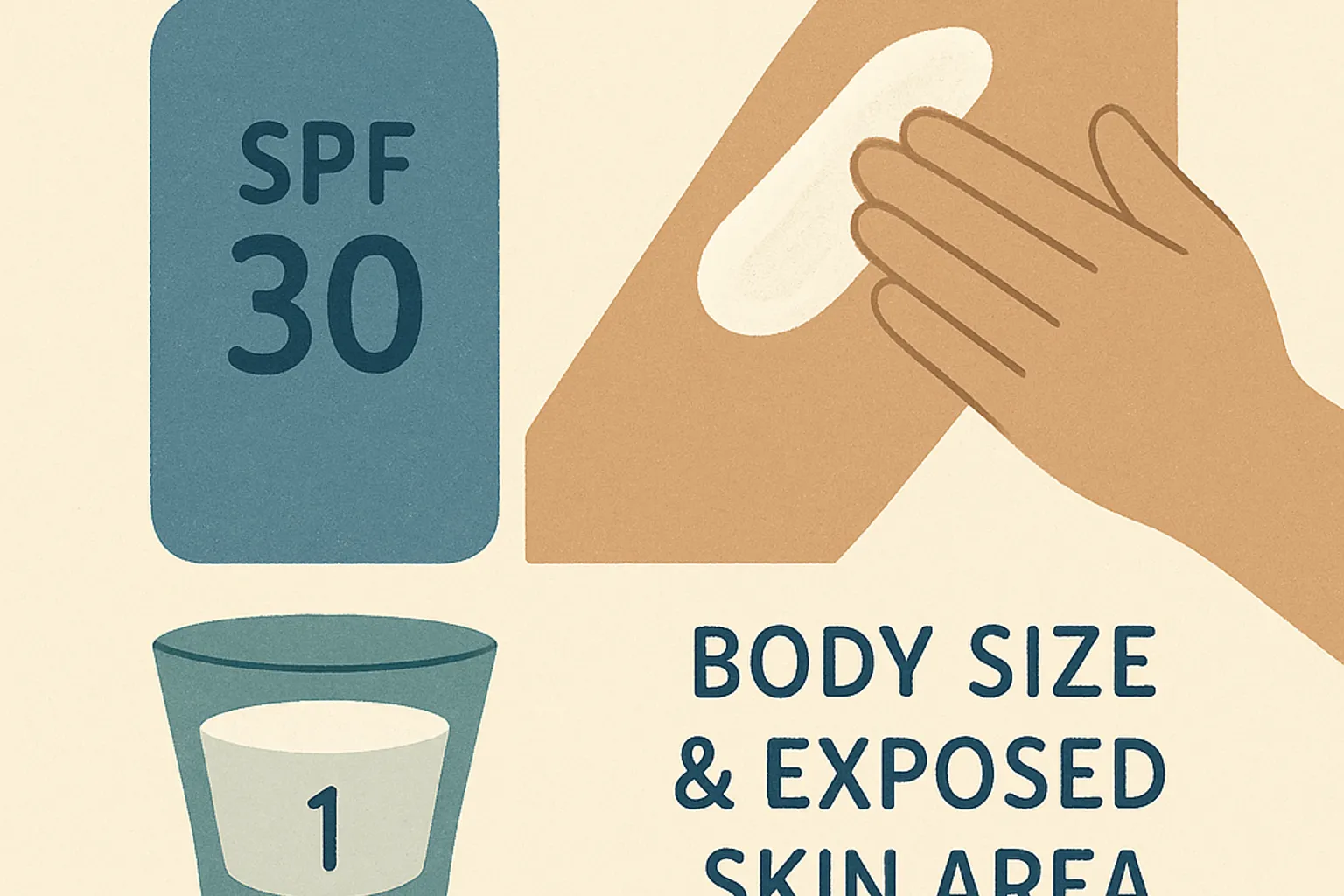
For exposed adult body skin, about one ounce — roughly a shot-glass amount — is a common public-health estimate. That is a rough guide, not a rule for every body. A taller body, more exposed skin, swimwear, shorts, or sleeveless clothing can change how much you need. More covered clothing can reduce the skin area that needs sunscreen.
For the face, some people use the two-finger rule as a reminder to use more than a pea-sized amount. It can be helpful as a cue, but it is not precise. Finger size, sunscreen texture, and whether you include the neck and ears all change the amount.
The better test is coverage: did you apply enough to create an even layer everywhere light will reach? If the answer is no, add more before you head outside.
Where sunscreen gets missed
Sunscreen routines often become less reliable at the edges. That does not mean you are careless. These areas are simply easy to skip when you are moving quickly.
Use the same order each time so you are not relying on memory in the moment. Start with the face, then the neck and ears. Move to exposed arms, hands, legs, and feet. Finish with a border check.
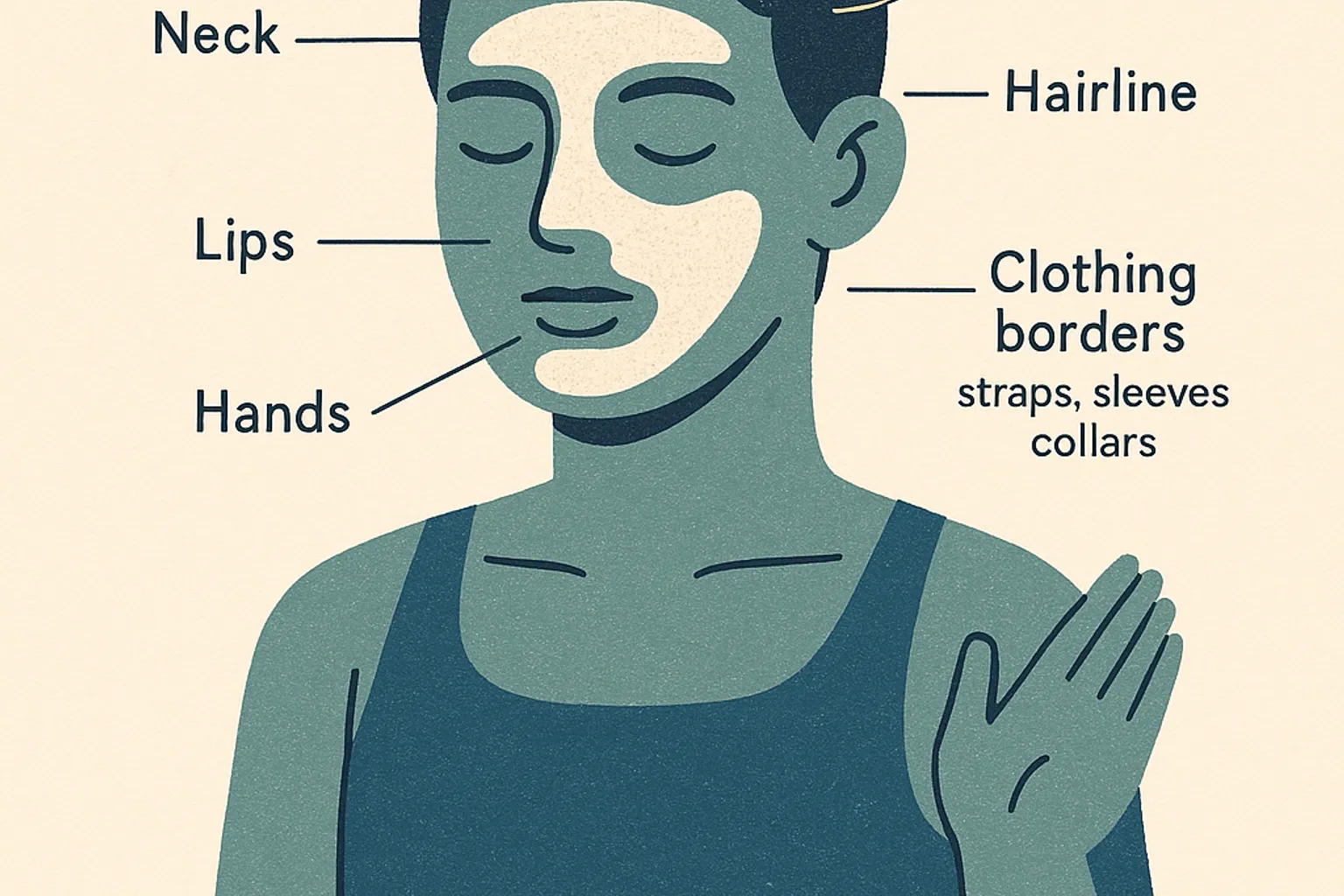
Pay special attention to the ears, back and sides of the neck, hairline or exposed scalp, lips, tops of the hands, tops of the feet, and the skin near straps, sleeves, collars, ankles, and waistbands.
If your hair part or scalp is exposed, it needs protection too. Depending on your hair and skin, that may mean sunscreen made for that area, a hat, or both.
For lips, choose a lip product with SPF when you will be outdoors. Regular sunscreen is not always pleasant or practical on the lips, and many people forget this area entirely.
Why higher SPF does not replace enough product
A higher SPF can be useful in some situations, especially when it is applied correctly. But it does not solve the basic problem of too little product or uneven coverage.
If SPF 50 is spread so thinly that it barely covers the skin, the number on the bottle cannot do all the work. The same is true if the sunscreen is applied well at 9 a.m. and then rubbed away by sweat, water, towels, clothing, or hands.
Think of higher SPF as one part of a margin, not permission to apply less. The routine still matters: enough product, even coverage, reapplication during ongoing outdoor exposure, and physical protection when the sun exposure is more intense or prolonged.
That physical protection can be simple. Shade, hats, sunglasses, and UPF or tightly woven clothing reduce how much skin is relying on sunscreen alone.
When and why to reapply
Sunscreen does not stay in a perfect film forever. Time, sweat, water, towel-drying, rubbing, touching your face, makeup adjustments, and clothing friction can all change the layer on your skin.
For ongoing outdoor exposure, general guidance is to reapply about every two hours. Reapply sooner after swimming, heavy sweating, towel-drying, or anything that visibly removes or moves the product.
This is not meant to make sunscreen feel extreme. Reapplication is simply maintenance. If the layer is what helps protect exposed skin, then rebuilding that layer during a long outdoor day helps keep the routine working.
On a normal indoor day with brief incidental exposure, your needs may look different from a beach day, a hike, an outdoor sports event, or a long walk at midday. Context matters. When exposure is longer, hotter, wetter, or more reflective, your routine has to do more work.
Sunscreen is one part of sun protection
Sunscreen is useful, but it should not be your only plan for prolonged sun exposure.
When you can, combine it with shade, a broad-brimmed hat, sunglasses, and protective clothing. This is especially helpful because clothing and shade do not depend on applying a perfectly even layer of product to every inch of exposed skin.
Some people need more individualized guidance. If you have a history of skin cancer, melasma or persistent hyperpigmentation, recent cosmetic or dermatologic procedures, pregnancy, photosensitizing medications, prescription actives such as retinoids, or a photosensitive condition, ask your dermatologist what sun-protection plan fits your skin.
That does not mean sunscreen is unsafe or useless. It means your risk factors, medications, procedures, and skin goals can change what a careful plan looks like.
A sunscreen routine you can trust
You do not need to apply sunscreen perfectly to make it worth using. But a more consistent routine can help you get closer to the protection the label describes.
Start with a broad-spectrum SPF 30 or higher. Choose water-resistant sunscreen when swimming or sweating is part of the day. Apply a generous, even layer to all exposed skin, then check the easy-to-miss areas: ears, neck, hairline, lips, hands, feet, and clothing borders.
During ongoing outdoor exposure, reapply about every two hours and sooner after swimming, sweating, towel-drying, or rubbing. Add shade, hats, sunglasses, and protective clothing when the exposure is longer or more intense.
The point is not fear or perfection. It is a routine you can repeat.
When to ask your dermatologist
If your sun-protection needs are shaped by melasma, a history of skin cancer, recent procedures, pregnancy, photosensitizing medications, or a routine with prescription actives, a dermatologist can help you adapt the routine to your skin.
Ask your dermatologist what sun-protection plan fits your skin.