Is Fruit-Based Skincare Actually Good for Your Skin? How to Read the Label
A calm guide to reading fruit-themed skincare labels, from fruit acids and enzymes to vitamin C, oils, butters, fragrance, and irritation risk.
14 min read By Dr. Lurie skincare #skincare #ingredients #marketing-claims #sensitive-skin
Fruit makes skincare feel healthier than it automatically is
Fruit is one of the easiest stories to sell in skincare. It looks fresh. It sounds harmless. It borrows the emotional glow of food: vitamins, juice, antioxidants, sweetness, nature.
That does not make fruit-based skincare fake. It also does not make it automatically gentle, effective, or better than a less romantic formula.
The useful question is simpler: what is the ingredient doing in this product, at this concentration, inside this full formula, on your actual skin?
The marketing story is not the same as the formula
A product can say “with pomegranate,” “berry complex,” or “citrus antioxidant blend” and still be mostly built from water, emollients, emulsifiers, preservatives, fragrance, or other functional ingredients.
That is not necessarily bad. Good formulas need boring ingredients. Preservatives help keep products safer. Emulsifiers help oil and water stay together. Texture ingredients can make a product easier to use.
The problem begins when the fruit story does all the emotional work while the actual formula gets ignored. A label can sound like a smoothie and still behave like a fragranced cosmetic.
Read the ingredient list from the boring end first
Do not start with the prettiest ingredient on the front label. Start with the ingredient list.
A practical scan:
1. Look for fragrance, parfum, essential oils, citrus peel oils, or other scent-heavy materials if your skin is reactive.
2. Notice whether the fruit extract is central to the formula or appears late in the list.
3. Ask what the product is mainly trying to do: moisturize, exfoliate, brighten the appearance of tone, cleanse, or simply smell pleasant.
4. Compare the claim with the category. A moisturizer should still moisturize. A cleanser should still cleanse without leaving your skin stripped.
This is not about becoming suspicious of everything. It is about refusing to let the front label do all the thinking for you.
Natural does not always mean gentle
This is the trap with fruit, flowers, herbs, and botanical language: “natural” feels emotionally safer than “synthetic.” But skin does not read branding.
Some people tolerate botanical extracts well. Others react to fragrance components, essential oils, acids, or a formula that is simply too active for their barrier at that moment.
The American Academy of Dermatology advises caution with plant-based botanical ingredients when irritation is a concern, because they may still include fragrance-related ingredients. It also commonly recommends fragrance-free products for sensitive or dry skin.
So the better rule is not “avoid fruit.” It is: if your skin is reactive, do not give fruit language a free pass.
When fruit ingredients can make sense
Fruit-derived ingredients can be reasonable in a skincare formula when they have a clear job and the product is well balanced.
For example, fruit acids may be part of exfoliating products. Some fruit extracts are included for antioxidant positioning, scent, color, texture, or marketing identity. Oils and butters from plants can contribute to the feel of a product, though the full formula still matters more than the ingredient story alone.
The point is not to reject every fruit ingredient. The point is to ask whether it is doing a useful job in a product that your skin can tolerate.
A calmer way to judge a fruit-based product
Use the same standard you would use for any skincare product:
- Does it match the job you bought it for?
- Does your skin feel comfortable after repeated use?
- Does the ingredient list fit your sensitivity level?
- Are the claims cosmetic and realistic, or are they drifting into treatment language?
- Would the product still make sense if the fruit image disappeared from the packaging?
The bottom line
Fruit in skincare is not the problem. The shortcut is the problem.
If fruit language makes a product easier to enjoy, that can have value. A routine you like is easier to keep. But enjoyment is not the same as evidence, and natural imagery is not the same as skin compatibility.
Buy the formula, not the fruit bowl. If your skin is sensitive, patch test carefully, keep the routine simple, and treat irritation as information rather than as something to push through.
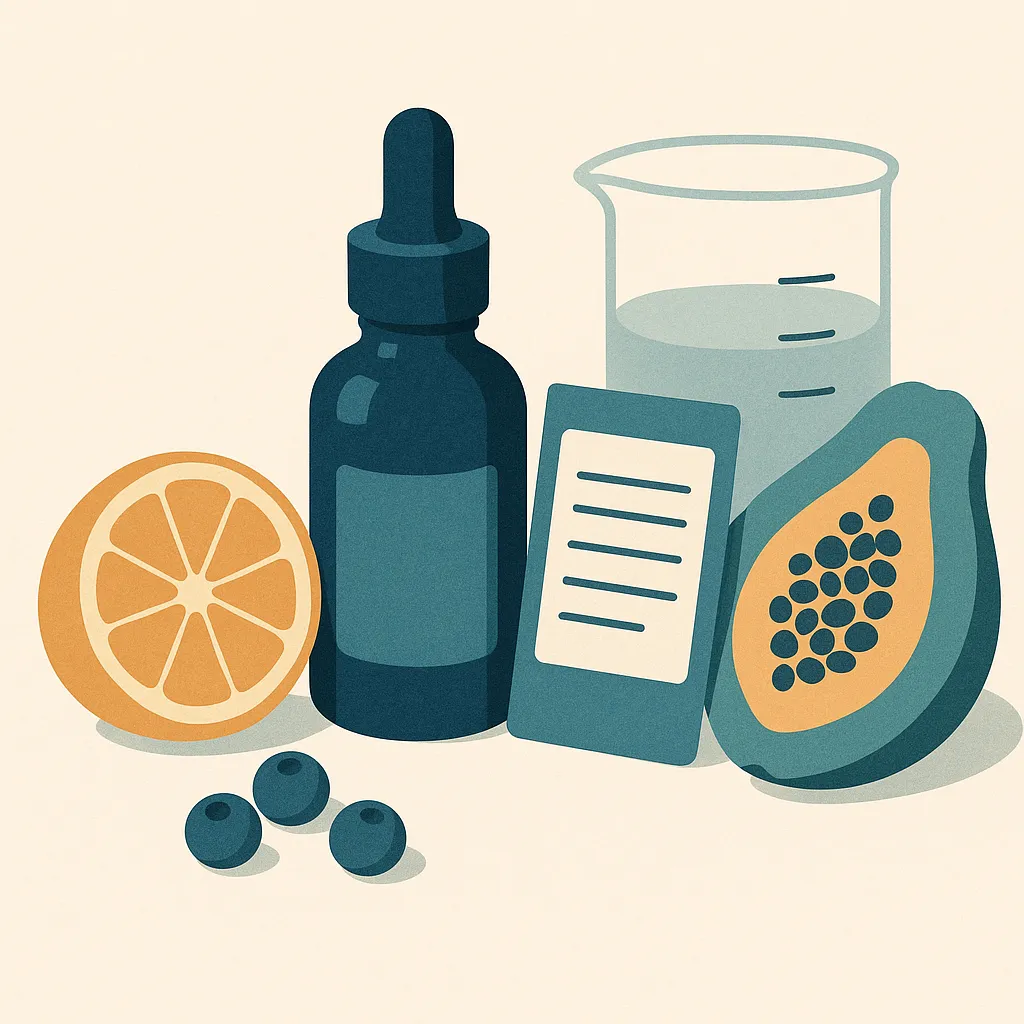
A citrus glow serum. A papaya enzyme mask. A berry antioxidant cream. A mango butter moisturizer.
Fruit language can make skincare feel fresh, familiar, and easy to trust. It sounds like something your skin should understand.
Quick answer
Fruit on a skincare label can point to an active ingredient, a moisturizer, a fragrance, or a marketing story. The useful habit is separating the story from the function: what is the ingredient doing in the full formula, and does that role fit your skin?
But the better question is not whether fruit is good for skin. The better question is what the fruit-related ingredient is doing in that specific formula.
Sometimes fruit points to a useful ingredient category. Sometimes it is mostly scent, texture, color, or marketing. The ingredient list is where the difference starts to show.
“Fruit-based” is not one skincare category
Fruit-based skincare can mean several different things, and they do not work the same way.
- A fruit extract added in a small amount
- An exfoliating acid associated with fruit, such as an alpha hydroxy acid
- An enzyme ingredient, often described with papaya or pineapple language
- A vitamin C or antioxidant story connected to citrus, berries, or other fruits
- A fruit oil, seed oil, or butter used for softness and texture
- A fragrance, essential oil, or aromatic peel oil
- A front-label theme that says little about the working parts of the formula
That is why two products with fruit on the front can be completely different on the skin. One may exfoliate. One may moisturize. One may mostly smell like fruit.
The ingredient list tells you which one you are buying. The formula around that ingredient tells you how relevant it may be.
When fruit-derived ingredients can matter
Some fruit-related ingredients can have a real role in a skincare product. The role depends on the ingredient category, not the fruit story alone.
Fruit acids and related exfoliating acids are usually included to help loosen surface buildup and smooth the feel of skin. That does not make them automatically gentle. How skin responds depends on the acid, the whole formula, how often it is used, and the condition of your skin.
Enzyme products are often marketed with papaya or pineapple language. Some people find enzyme-style exfoliating products easier to tolerate than stronger-feeling exfoliants, but they can still be irritating for some people. Sensitive, reactive, over-exfoliated, or already uncomfortable skin may need a simpler routine.
Vitamin C and antioxidant products are another category. A dermatology review has described topical vitamin C as a studied skincare ingredient, especially when formulation and delivery are considered. The important caveat is that vitamin C can be unstable and difficult to deliver well, so the formula matters.
That means a citrus, berry, or tropical fruit extract should not be treated as the same thing as a well-formulated vitamin C product. Some fruit-derived ingredients are included for antioxidant potential, but benefit depends on the specific compound, formulation, stability, and how much is present.
Fruit oils, seed oils, and butters belong in a different mental category. Ingredients such as avocado oil, olive oil, coconut oil, mango butter, or similar oils and butters are usually better understood as texture-supporting, softening, or moisture-sealing ingredients. They may suit dryness in some people, while feeling too rich for others, especially if a routine already feels heavy or breakout-prone.
Fruit acid does not always mean gentle
This is one of the most common label traps. “Fruit acid” sounds softer than “acid,” but the skin does not judge an exfoliant by how natural the name sounds.
Exfoliation is about the finished product. The same broad ingredient family can feel very different depending on the formula, the strength of the product, the skin it is used on, and what else is already in the routine.
If your skin is already irritated, a fruit-acid product may be the wrong next step, even if it is marketed as gentle. Burning, peeling, tightness, or a rash-like reaction is not a sign that a product is “working.” It can be a reason to pause, simplify, and stop using the product that seems to be causing the problem.
This is especially relevant if you already use retinoids, acne prescriptions, exfoliating acids, or several active products. The issue is not that fruit-based skincare is bad. It is that stacking too many stimulating products can make skin harder to read.
Papaya and pineapple enzyme products still need a skin-fit check
Papaya and pineapple are often used to make an exfoliating product feel approachable. You may see papain, bromelain, or fruit enzyme language on masks, cleansers, and polishing products.
The appeal is understandable. Enzyme language can sound precise and less harsh than scrub or peel language.
Still, “enzyme” does not mean irritation-proof. If your skin is sensitive, reactive, recently over-exfoliated, or already stinging with simple products, an enzyme product can still be too much.
For most people, the practical question is simple: does this product add something your routine actually needs, and does your skin tolerate it without stinging, redness, tightness, or lingering discomfort?
Vitamin C, berries, and antioxidant claims need context
Fruit-themed products often lean on antioxidant language. Citrus and berry ingredients are especially common in this kind of marketing.
There is evidence behind topical vitamin C as a dermatology ingredient, but the evidence does not make every fruit extract equivalent. A review in the Indian Dermatology Online Journal notes that topical vitamin C is difficult to formulate because stability and skin delivery matter.
So the label question is not, “Does this contain a fruit associated with vitamin C?” The better question is, “What form of antioxidant ingredient is actually listed, and is the product built around it in a credible way?”
A fruit extract near the end of the ingredient list may still be part of a pleasant formula. It just should not be assumed to perform like a dedicated vitamin C serum.
It also should not replace sunscreen. Antioxidant skincare and sunscreen have different jobs, and fruit language on a cosmetic label does not change that.
Fruit oils and butters are usually about comfort, not correction
Avocado, olive, coconut, mango, and other fruit-derived oils or butters can be useful in moisturizers, balms, and richer creams. In most formulas, their job is to help the product feel softer, richer, or more protective on the surface of the skin.
That can be helpful if your skin feels dry or tight. It can be less helpful if you already dislike rich textures or find that heavier products contribute to clogged-feeling skin.
This does not make the ingredient good or bad. It makes skin fit important.
A mango butter moisturizer and a papaya enzyme mask may both look “fruit-based,” but they are solving different problems. One is mainly about comfort and texture. The other may exfoliate.
Sometimes the fruit is mostly fragrance
Fruit language can also signal scent. A product may smell like citrus, berries, or tropical fruit because it contains fragrance, essential oils, citrus peel oils, or other aromatic ingredients.
If your skin is sensitive or reactive, it is worth checking for broad label terms such as fragrance, parfum, essential oil, or citrus peel oil. These ingredients are not automatically a problem for everyone. They are simply more relevant when your skin tends to sting, flush, itch, or develop rash-like reactions from products.
This is where front-label fruit imagery can be misleading. A bright orange or berry picture may make the product feel nourishing, but the ingredient list may show that the fruit experience is mainly aromatic.
For a reader with calm, resilient skin, that may be fine. For a reader with a history of irritation, it may be the reason to choose something plainer.
How to read a fruit-based skincare label
You do not need to become a cosmetic chemist to make a better decision. Start with five practical questions.
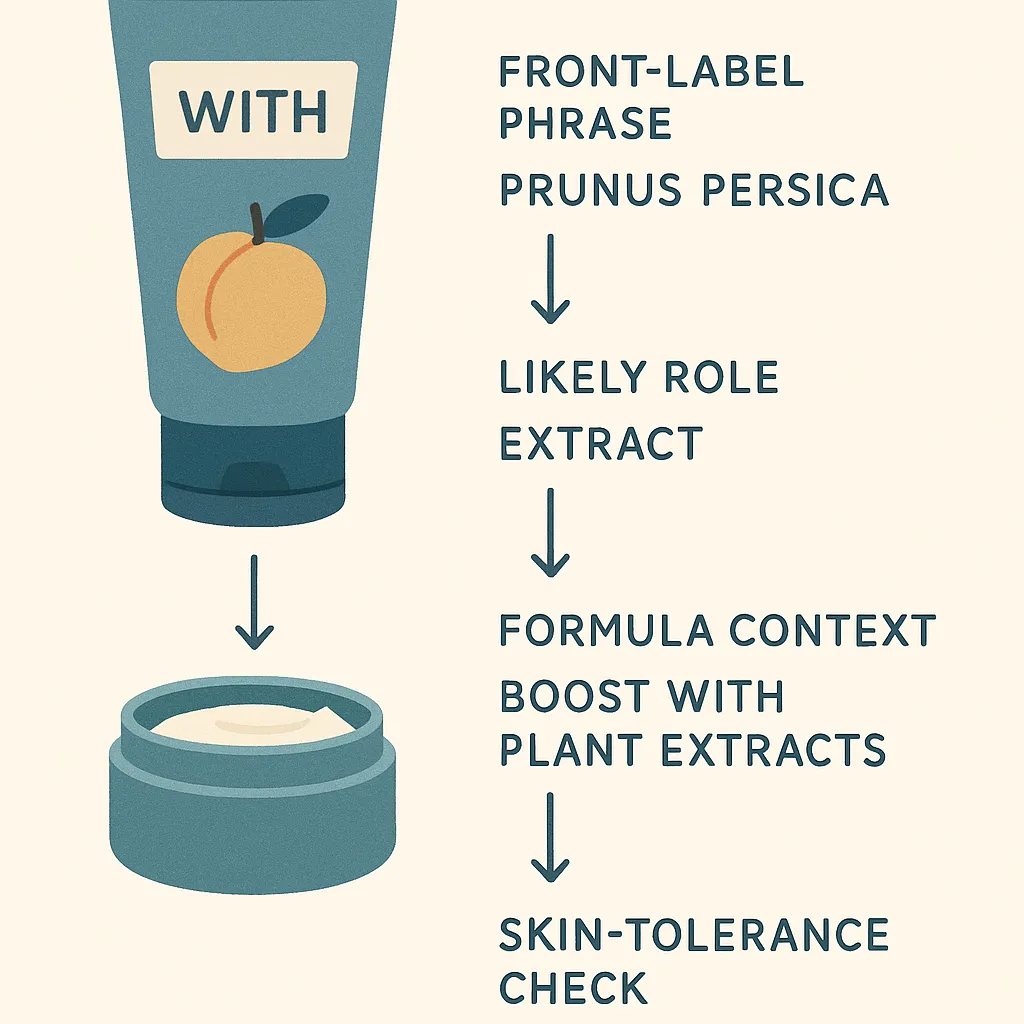
- What is the fruit claim on the front label? Is it citrus glow, papaya enzyme, berry antioxidant, mango butter, or something else?
- Can you find the related ingredient in the ingredient list? Look for the named extract, oil, butter, acid, enzyme, vitamin C derivative, fragrance, or essential oil.
- What role does that ingredient probably have? Is it exfoliating, moisturizing, antioxidant-focused, aromatic, or mostly a small botanical addition?
- Does the whole formula match your skin goal? A fruit extract does not make a harsh routine gentle, and a fruit oil does not make every product right for acne-prone skin.
- Does your skin tolerate this category? Your own pattern with acids, enzymes, fragrance, rich oils, and active products matters.
The most useful label habit is separating the story from the function. Fruit can be the source of an ingredient, the scent of a product, the texture cue, or the marketing theme. Those are not the same thing.
Two simple label examples
Example one: a papaya-themed mask may be using fruit language to point toward exfoliation. If you already use retinoids, acids, or acne prescriptions, the question is whether you need another exfoliating step at all.
Example two: a citrus-scented cream may feel energizing because of its fragrance rather than because the fruit claim is doing the main skincare work. If fragrance has bothered your skin before, the simpler choice may be the better fit.
When to be more cautious
Use more caution with fruit-based skincare if your skin already feels disrupted or uncomfortable. Signs can include stinging with bland products, tightness, peeling, burning, or a new rash-like reaction.
Also be careful if you are using prescription acne treatments, retinoids, exfoliating acids, or multiple active products. Adding a fruit acid or enzyme product may make irritation harder to trace.
If you have a diagnosed skin condition, persistent pigmentation, ongoing acne flares, a rash, pregnancy-related concerns, or symptoms that do not settle after stopping a product, it is safer to raise it with your dermatologist. A label guide can help you ask better questions, but it cannot diagnose your skin.
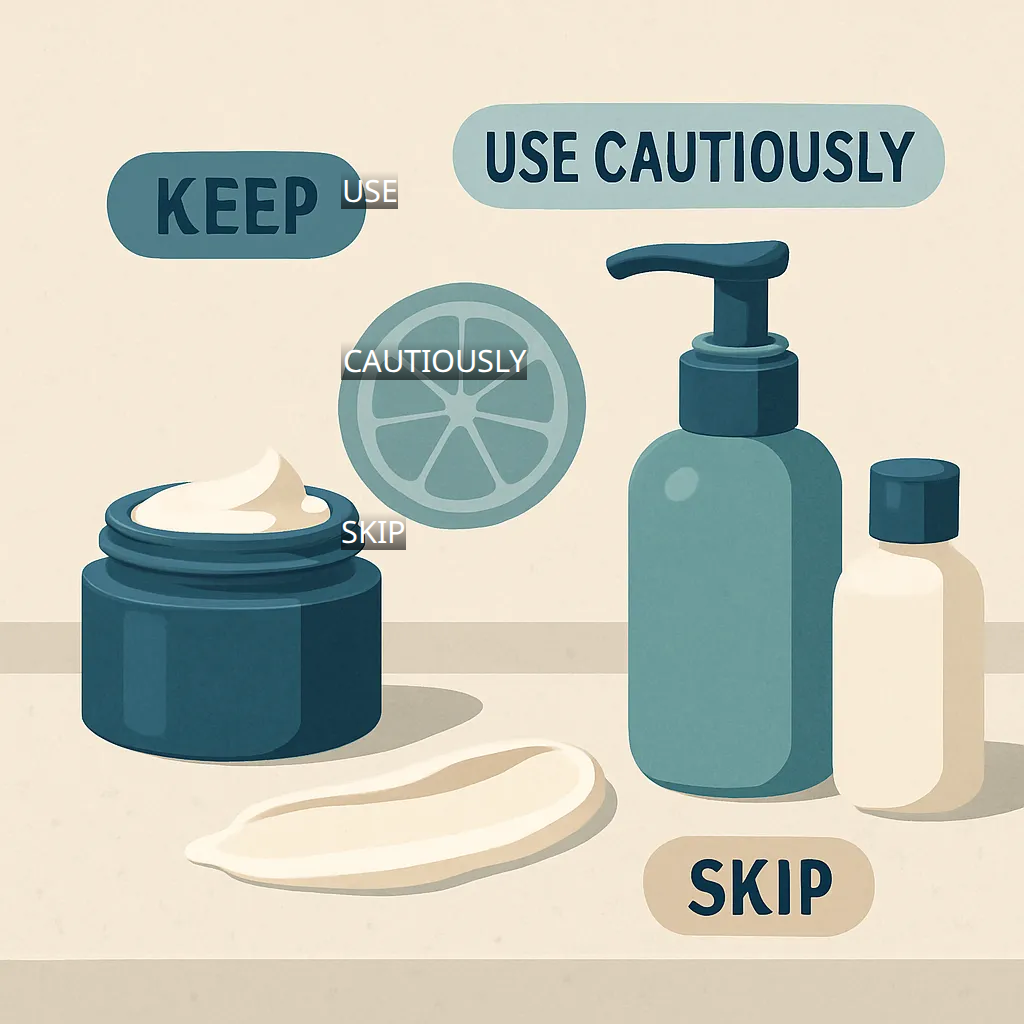
Keep, use cautiously, or skip: a simple checklist
Keep it if
- The fruit-related ingredient has a clear role in the formula.
- The product matches a real skin goal, such as dryness, dull-feeling texture, or a preference for a certain moisturizer feel.
- Your skin tolerates it without stinging, burning, peeling, itching, or lingering redness.
- It does not duplicate several other active products already in your routine.
Use it cautiously if
- It exfoliates, especially if you already use acids, retinoids, or acne treatments.
- It contains fragrance, essential oils, or citrus peel oils and your skin is reactive.
- It is a rich oil or butter formula and you are prone to clogged-feeling skin.
- Your skin is already irritated or your routine has recently become more complicated.
Skip it if
- The fruit claim is vague and you cannot tell what the ingredient is supposed to do.
- The product relies mostly on scent, color, or a natural-sounding story.
- It promises treatment-level results for acne, rashes, rosacea, eczema, melasma, or other medical concerns.
- It adds another exfoliant or active step you do not need.
- It irritates your skin and the irritation returns when you try it again.
The bottom line
Fruit-based skincare is not automatically better, cleaner, safer, or more effective. It is also not automatically useless.
The value is in the specific ingredient, the finished formula, and your skin’s tolerance. A papaya enzyme mask, citrus vitamin C serum, berry extract cream, and mango butter moisturizer may all use fruit language, but they are not doing the same job.
When the label gives you a clear ingredient role and your skin responds comfortably, a fruit-derived ingredient can fit into a routine. When the label gives you mostly a scent or a story, you do not need to treat it as skincare evidence.